

 español
 English
 français
 Deutsch
 العربية
 中文
中文
¿Su sistema UPS le está costando dinero en secreto? Aquí le mostramos cómolos filtros activos de armónicospueden ayudar
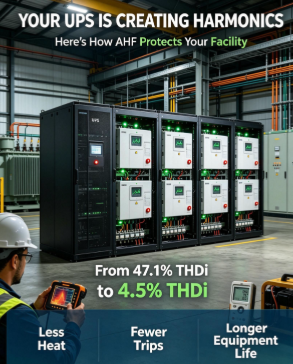
Su UPS (fuente de alimentación ininterrumpida) debe ser su salvaguarda: la póliza de seguro que mantiene sus operaciones críticas en funcionamientocuando falla la red eléctrica. Pero aquí está la ironía: ese mismo UPS podría estar dañando silenciosamente sus equipos, aumentando sus facturas de electricidad y amenazando la estabilidad de todo su sistema eléctrico.
¿Cómo? Mediante la distorsión armónica.
Desglosemos los problemas de calidad de energía que crean los sistemas UPS, cómo los filtros activos de armónicos (AHF) los solucionan y, lo más importante, qué debe tener en cuenta al implementar AHF en entornos con UPS.
Los sistemas UPS son cargas no lineales. A diferencia de las cargas resistivas simples (como un calentador), los rectificadores de UPS consumen corriente en pulsos cortos y pronunciados en lugar de una onda sinusoidal uniforme. Esta acción pulsante inyecta corrientes armónicas de regreso al sistema de distribución eléctrica.
Esto es lo que realmente significa para sus instalaciones:
Un UPS rectificador estándar de 6 pulsos normalmente produce una distorsión armónica total de corriente (THDi) del 30% o más. Los armónicos predominantes son los órdenes 5.º, 7.º, 11.º y 13.ºIncluso los sistemas UPS de 12 pulsos, aunque son mejores, todavía generan armónicos significativos de 11.º y 13.º orden
Lo que esto le ocasiona: estas corrientes armónicas no realizan trabajo útil; simplemente circulan por su sistema, calentando cables y transformadores.
Un UPS de 6 pulsos normalmente opera con un factor de potencia de solo 0,75 a 0,8. Eso significa que, por cada 100 kVA de potencia aparente que paga, solo 75-80 kVA realizan realmente trabajo útil. El resto se desperdicia.
Lo que esto le ocasiona: está pagando a la compañía eléctrica por energía que no puede utilizar. Si funciona con un generador diésel, la situación es aún peor: el generador puede necesitar ser de 2,5 a 3 veces la capacidad nominal del UPS solo para manejar las corrientes armónicas.
Las corrientes armónicas que fluyen a través de la impedancia del sistema crean distorsión de voltaje. Esto no solo afecta al UPS, sino a todos los equipos conectados al mismo bus
Lo que esto le ocasiona: los equipos sensibles (por ejemplo: servidores, PLC, dispositivos médicos e instrumentos de laboratorio) pueden fallar, proporcionar lecturas falsas o apagarse inesperadamente.
Las corrientes armónicas causan calentamiento adicional en transformadores, cables, condensadores y motores. Los bancos de condensadores son especialmente vulnerables: pueden sufrir averías graves debido a la sobrecarga armónica.
Lo que esto le ocasiona: los equipos fallan antes de lo esperado. Los transformadores reducen su capacidad. Los interruptores automáticos se disparan sin motivo aparente. Y usted queda intentando reemplazar componentes costosos.
En sistemas trifásicos de cuatro hilos, los armónicos triples (3.º, 9.º, 15.º, etc.) no se cancelan en el neutro; se suman.
Lo que esto le ocasiona: los conductores neutros pueden sobrecalentarse y convertirse en un riesgo de incendio, incluso cuando las corrientes de fase están equilibradas.
Un filtro activo de armónicos no es un dispositivo pasivo de "configúrelo y olvídese". Es un sistema dinámico e inteligente que supervisa continuamente su forma de onda eléctrica y cancela activamente los armónicos en tiempo real.
Así es como nuestro AHF aborda cada problema de calidad de energía relacionado con UPS:
Solución AHF: nuestro AHF detecta las corrientes armónicas en tiempo real e inyecta una corriente exactamente opuesta (en contrafase) para cancelarlasEl resultado: el THDi puede reducirse a menos del 5%. En aplicaciones reales con UPS, hemos observado que el THDi disminuye de 47,1% a solo 4,5%.
Solución AHF: además del filtrado de armónicos, nuestro AHF proporciona compensación dinámica de potencia reactiva. Puede corregir el factor de potencia a 0,99 o superior. Eso significa que deja de pagar por energía que no utiliza.
Solución AHF: al eliminar las corrientes armónicas en la fuente, nuestro AHF evita que ocurra la distorsión de voltaje desde el principio. Una corriente limpia significa un voltaje limpio para todos los dispositivos conectados a su bus.
Solución AHF: La energía limpia significa menos calentamiento. Menos calentamiento significa una vida útil más larga del equipo. Los transformadores funcionan a menor temperatura. Los cables se mantienen dentro de su capacidad nominal. Los bancos de condensadores dejan de fallar prematuramente.
Solución AHF: Nuestro AHF compensa los armónicos de 3er orden y otros órdenes triples, eliminando el problema de sobrecarga del neutro.
Rango de compensación: del 2.º al 50.º orden armónico
Tiempo de respuesta: ≤5 milisegundos
THDi después de la compensación: ≤5%
Factor de potencia después de la compensación: ≥0.99
Diseño modular para una fácil escalabilidad
Topología de inversor de tres niveles para alta eficiencia
Implementar AHF en entornos UPS es altamente eficaz, pero como cualquier solución de calidad de energía, hay aspectos que debe conocer. Estas son las preguntas más comunes que recibimos de los clientes:
P1: ¿Puede AHF causar problemas de resonancia con los bancos de condensadores existentes?
R: Sí, es una preocupación real. Los sistemas UPS suelen tener condensadores de corrección del factor de potencia, y estos condensadores pueden crear condiciones de resonancia cuando se combinan con la impedancia del sistema. La resonancia puede amplificar realmente la distorsión armónica en lugar de reducirla.
Nuestro enfoque: Nuestro AHF está diseñado con algoritmos de control adaptativo que evitan activamente la resonancia. A diferencia de los filtros pasivos (que tienen puntos de ajuste fijos que pueden entrar en resonancia), nuestro AHF ajusta dinámicamente su compensación para evitar la amplificación armónica. También recomendamos un estudio exhaustivo del sitio antes de la instalación para identificar cualquier riesgo de resonancia.
P2: ¿Qué ocurre con la "compensación incorrecta" o la "sobrecompensación"? He escuchado historias alarmantes.
R: Es una preocupación válida; se sabe que algunos productos AHF antiguos o de baja calidad han realizado compensaciones incorrectas, provocando que los interruptores principales de entrada se disparen o que los equipos fallen. Esto suele ocurrir cuando el tiempo de respuesta del AHF es demasiado lento (por ejemplo, 40 ms o más).
Nuestra ventaja: Nuestro AHF tiene un tiempo de respuesta de ≤5 ms, ocho veces más rápido que los productos problemáticos. Esto significa que sigue los cambios de carga en tiempo real sin "excederse" ni "perder" los armónicos. El controlador avanzado DSP+FPGA garantiza una compensación precisa y estable.
P3: ¿Dónde debería instalar el AHF: en el UPS o en el tablero principal de distribución?
R: Depende de su configuración específica. Hay dos enfoques principales
Instalación del lado de la carga (local): Instale el AHF directamente en el UPS. Esto evita que los armónicos entren en su sistema de distribución. Es ideal cuando una o pocas unidades UPS grandes son las principales fuentes de armónicos.
Instalación del lado de la fuente (central): Instale un AHF grande en la alimentación principal de entrada. Esto proporciona protección para todo el sistema y es más rentable cuando tiene muchas fuentes de armónicos distribuidas.
Nuestra recomendación: Para la mayoría de los entornos con muchos UPS, recomendamos un enfoque híbrido: AHF central para los armónicos base, además de unidades AHF dedicadas para sistemas UPS grandes.
P4: ¿El AHF afecta al propio UPS? ¿Podría interferir con el funcionamiento del UPS?
R: No; cuando se instala correctamente, el AHF funciona en paralelo con el UPS, no en serie. No altera el control interno ni el funcionamiento del UPS. El AHF simplemente "detecta" las corrientes armónicas y las cancela en el punto de conexión. El UPS continúa funcionando exactamente como fue diseñado, pero con energía más limpia en ambos lados.
P5: ¿Qué ocurre si falla el AHF? ¿Pierdo toda mi protección contra armónicos?
R: Esto depende de la arquitectura de instalación. Si depende de un único AHF central, una falla significa perder la protección contra armónicos de todo el sistema.
Nuestra solución: Nuestro AHF cuenta con un diseño modular. Puede implementar varios módulos en paralelo; si uno falla, los demás continúan funcionando. Para entornos UPS críticos, recomendamos redundancia N+1 para garantizar una protección contra armónicos ininterrumpida.
P6: ¿Puede el AHF manejar condiciones de carga parcial? Los sistemas UPS suelen funcionar muy por debajo de su capacidad nominal.
R: Absolutamente, y de hecho aquí es donde el AHF supera a los filtros pasivos. Los filtros pasivos están ajustados para condiciones de carga específicas y se vuelven menos efectivos con cargas parciales. Nuestro AHF se adapta continuamente a las condiciones de carga cambiantes. Ya sea que su UPS esté al 10% o al 100% de carga, el AHF realiza el seguimiento y la compensación en tiempo real.
Nota: Los sistemas UPS que funcionan con cargas muy bajas (por ejemplo, 6%) aún pueden tener un THDi alto (alrededor del 30%)-. Nuestro AHF lo gestiona con la misma eficacia que en condiciones de carga completa.
P7: ¿Vale la pena la inversión en AHF para un solo UPS?
R: Depende del tamaño del UPS y de la sensibilidad de sus instalaciones a los problemas de calidad de energía. Para un UPS grande (100 kVA o más) que alimenta cargas críticas, la respuesta casi siempre es sí. Considere:
Ahorros por reducción de las facturas de electricidad (5-12%)
Vida útil prolongada de los equipos (transformadores, cables, condensadores)
Costos evitados por tiempo de inactividad
Cumplimiento de las normas de armónicos de las empresas eléctricas (como IEEE 519)
En muchos casos, el período de recuperación de la inversión es inferior a 18 meses.
Nuestro equipo se especializa en soluciones de calidad de energía para instalaciones críticas. Entendemos los desafíos únicos de los entornos de UPS y podemos proporcionar recomendaciones personalizadas.
Contáctenos sales@yt-electric.com hoy para programar una auditoría de calidad de energía y descubrir cuánto podría estar ahorrando.



 compatible con la red ipv6