

 español
 English
 français
 Deutsch
 العربية
 中文
中文
Las líneas de ensamblaje automotriz operan con una volatilidad extrema de carga. Los equipos de elevación de alta potencia y los soldadores robóticos requieren potencia reactiva instantánea durante los ciclos de arranque. Los sistemas tradicionales de compensación basados en capacitores no logran seguir estos transitorios de nivel milisegundo, lo que provoca penalizaciones severas por factor de potencia y caídas de tensión en el bus.
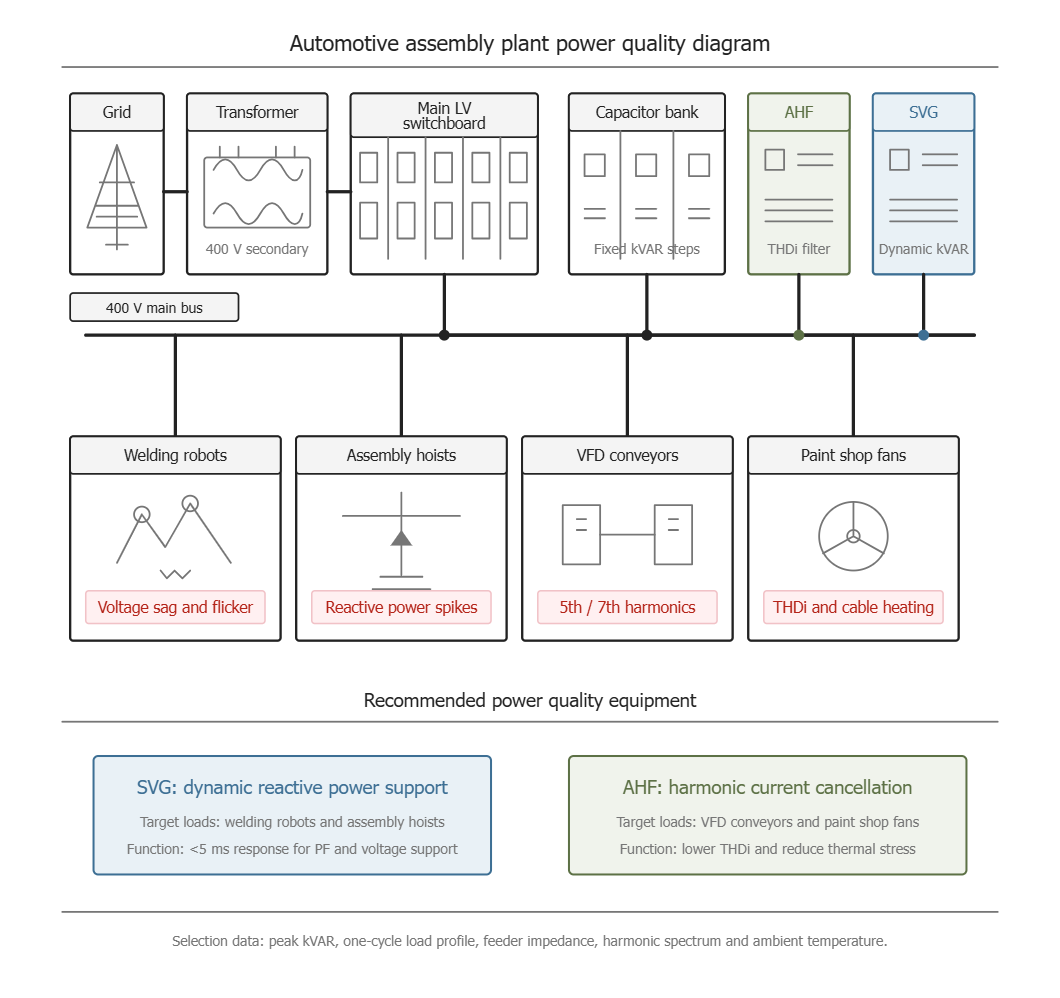
Los robots de soldadura, polipastos de ensamblaje, transportadores con VFD y ventiladores del taller de pintura crean caídas de tensión, picos de potencia reactiva y distorsión armónica en una planta de ensamblaje automotriz.SVGproporciona compensación rápida de potencia reactiva para cargas dinámicas, mientras que AHF reduce la THDi de los equipos accionados por VFD.
Los sistemas de elevación automotrices utilizan motores de inducción de alto par que realizan ciclos cada pocos segundos. Estos motores consumen corrientes reactivas masivas durante las fases iniciales de magnetización y aceleración. Los contactores mecánicos tradicionales requieren de 20 ms a 100 ms para conmutar etapas de capacitores. Este retraso provoca un desajuste entre el requisito de carga y la salida de compensación.
Los operadores de red miden el factor de potencia con alta resolución. Un factor de potencia atrasado durante el arranque del motor provoca recargos inmediatos de la empresa eléctrica. Además, el lento tiempo de descarga de los capacitores impide una reinserción rápida, dejando al sistema sin protección durante ciclos de carga consecutivos.
Una compensación inadecuada provoca caídas significativas de tensión en el bus de distribución. Estas fluctuaciones interfieren con controladores PLC sensibles y sensores robóticos. El tiempo de inactividad operativo aumenta cuando los sistemas de control se desconectan debido a condiciones transitorias de subtensión.
La compensación de potencia reactiva SVG utiliza una arquitectura de convertidor de fuente de tensión (VSC). A diferencia de los capacitores pasivos, el SVG funciona como una fuente de corriente controlada. Rastrea la corriente de carga en tiempo real utilizando procesadores digitales de señales (DSP) de alta velocidad. El sistema calcula el componente reactivo exacto requerido e inyecta una corriente igual y opuesta en un plazo de 5 milisegundos.
Esta velocidad de respuesta surge de la eliminación de componentes de conmutación mecánica. Los interruptores electrónicos de potencia, específicamente los IGBT, modulan la salida a altas frecuencias. El SVG permanece sincronizado con la frecuencia de la red, proporcionando transiciones fluidas entre compensación capacitiva e inductiva.
La precisión es importante en entornos dinámicos. El SVG proporciona un ajuste continuo y sin escalones de la potencia reactiva. Mantiene un factor de potencia objetivo de 0.99 independientemente de la magnitud de la carga. Este nivel de precisión es matemáticamente imposible para bancos de capacitores de pasos fijos.
YT Electric emplea una topología de punto neutro fijado con diodos de 3 niveles (NPC) en sus sistemas SVG. Los convertidores estándar de 2 niveles producen un alto contenido armónico y un esfuerzo significativo de tensión (dv/dt) en el filtro de salida. La arquitectura de 3 niveles utiliza estados de conmutación adicionales para aproximarse más a una onda sinusoidal.
Este diseño reduce la tensión aplicada a cada IGBT en un 50%. Una menor tensión prolonga la vida útil de la electrónica de potencia. También minimiza las pérdidas de conmutación, aumentando la eficiencia energética general del gabinete.
La gestión térmica es crítica para plantas automotrices que operan a temperaturas ambiente de 45 °C. La topología de 3 niveles distribuye el calor de manera más uniforme entre los módulos de potencia. Se requieren reactores de salida más pequeños, reduciendo el tamaño y el peso del equipo.
Tabla A: Comparación técnica
|
Característica |
Banco de contactores mecánicos |
SVG (topología de 3 niveles) |
|
Tiempo de respuesta |
20 ms – 100 ms |
|
|
Tipo de compensación |
Por pasos (discreta) |
Sin escalones (continua) |
|
Precisión de control |
Limitada por el tamaño del paso |
Precisa (factor de potencia objetivo 0.99) |
|
Impacto armónico |
Riesgo de resonancia |
Capacidad de filtrado activo |
|
Esfuerzo de tensión (dv/dt) |
Alto |
Bajo (salida multinivel) |
|
Mantenimiento |
Alto (desgaste de contactos) |
Bajo (estado sólido) |
La compensación dinámica de potencia reactiva aborda directamente los problemas de estabilidad de tensión. Al inyectar corriente reactiva durante el pico de arranque del motor, el SVG evita la caída de tensión normalmente asociada con alimentadores de alta impedancia. Este "soporte de tensión" garantiza que las líneas de producción automatizadas permanezcan operativas sin disparos molestos.
Los altos niveles de THDi (Distorsión Armónica Total) suelen acompañar a las cargas VFD automotrices. Los armónicos excesivos aumentan el estrés térmico en cables y transformadores. Los capacitores tradicionales presentan riesgo de resonancia con la impedancia del sistema, lo que puede amplificar estos armónicos.
El SVG actúa como un amortiguador contra la distorsión armónica. Su capacidad de conmutación de alta frecuencia le permite mitigar armónicos de orden inferior mientras realiza la corrección del factor de potencia. Esta doble funcionalidad protege los equipos de distribución aguas arriba contra el envejecimiento prematuro.
La selección de la capacidad correcta del SVG requiere una auditoría detallada de calidad de energía. Los ingenieros deben analizar la demanda máxima de potencia reactiva durante el ciclo de producción más exigente. Basarse en datos promedio del factor de potencia conduce a sistemas subdimensionados que no pueden manejar los picos transitorios.
Los factores ambientales determinan las especificaciones del hardware. Las plantas automotrices suelen presentar altas concentraciones de polvo y temperaturas ambiente elevadas. YT Electric recomienda gabinetes con canales de refrigeración independientes y PCBs con recubrimiento conformal para garantizar la fiabilidad.
La integración con los sistemas de distribución existentes debe ser perfecta. El SVG debe admitir los protocolos Modbus TCP o Profibus para la monitorización remota. Esta conectividad permite a los equipos de mantenimiento supervisar el factor de potencia en tiempo real y el estado del dispositivo desde la sala de control central.
Tabla B: Matriz de selección de ingeniería
|
Escenario de aplicación |
Capacidad recomendada |
Requisito clave |
|
Soldadura de carrocería en blanco |
150kVAR – 300kVAR |
Seguimiento rápido de transitorios |
|
Elevador de ensamblaje final |
50kVAR – 150kVAR |
Supresión de caídas de tensión |
|
Manipulación de aire del taller de pintura |
100kVAR – 250kVAR |
Mitigación de armónicos |
|
HVAC e infraestructura |
30kVAR – 100kVAR |
Corrección del FP en estado estacionario |
Un sitio industrial representativo en Alemania experimentó penalizaciones mensuales por factor de potencia superiores a 2.400 €. La planta utilizaba transportadores de alta resistencia y paletizadores automatizados. Los bancos de capacitores existentes no podían responder a los ciclos de carga de 2 segundos, lo que resultó en un factor de potencia promedio registrado de 0,82.
YT Electric implementó una solución SVG de 300kVAR basada en una topología de 3 niveles. El sistema se instaló en la barra principal de distribución de 400V. Los ingenieros configuraron el dispositivo para priorizar la compensación de potencia reactiva con mitigación armónica secundaria.
Los resultados técnicos fueron inmediatos. El factor de potencia promedio se estabilizó en 0,99 durante la primera semana. Las fluctuaciones de tensión en la barra disminuyeron del 8% a menos del 2%. Las penalizaciones de la compañía eléctrica se eliminaron, dando como resultado un ROI del proyecto de aproximadamente 14 meses.
1.¿Cómo calculo la capacidad de SVG requerida para una línea de ensamblaje dinámica?
La selección de capacidad debe basarse en la diferencia entre la demanda máxima de potencia reactiva y el requisito del factor de potencia objetivo. Recomendamos utilizar un analizador de calidad de energía para capturar datos con resolución de 1 ciclo durante la producción máxima.
2.¿Puede instalarse el SVG junto con bancos de capacitores existentes?
Sí, el SVG es compatible con sistemas de capacitores heredados. Puede funcionar en modo "híbrido", donde los capacitores manejan la carga reactiva base y el SVG gestiona las fluctuaciones dinámicas.
3.¿Qué mantenimiento requiere un SVG de 3 niveles?
El mantenimiento se centra principalmente en limpiar los filtros de aire e inspeccionar los ventiladores de refrigeración cada 6 a 12 meses. El sistema de control digital proporciona autodiagnósticos para alertar a los operadores sobre cualquier irregularidad de los componentes.
4.¿Cómo mejora la topología de 3 niveles la vida útil del sistema?
El diseño NPC de 3 niveles reduce a la mitad el estrés de tensión sobre los IGBT individuales en comparación con los diseños de 2 niveles. Un menor dv/dt y unas pérdidas de conmutación reducidas conducen a temperaturas de funcionamiento más bajas.
Explore las especificaciones de productos de YT Electric y la guía de aplicaciones: https://www.ytelect.com/blog/guide-to-selecting-active-harmonic-filters_b321
Referencia: IEEE 519-2022, Estándar IEEE para el Control de Armónicos en Sistemas Eléctricos de Potencia: https://standards.ieee.org/ieee/519/10677/
¿Necesita una solución específica para su sitio? Comparta su diagrama unifilar, lista de cargas, factor de potencia medido, datos de THDi/TDD y condiciones ambientales con YT Electric. Nuestros ingenieros de ventas pueden revisar los datos y preparar una propuesta técnica.



 compatible con la red ipv6