

 español
 English
 français
 Deutsch
 العربية
 中文
中文
Caso práctico técnico: Sistema de almacenamiento de energía en Singapur
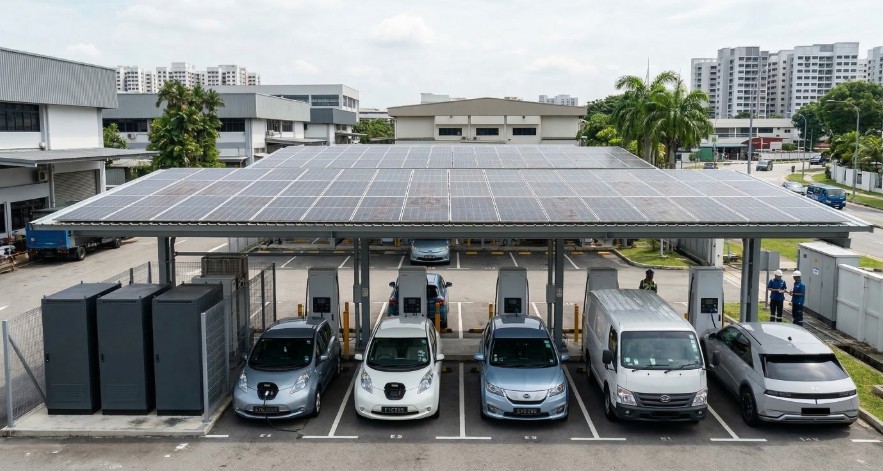
El compromiso de Singapur con el Plan Verde 2030 ha acelerado la adopción de vehículos eléctricos (VE) en toda la isla. Para los operadores comerciales, el desafío radica en gestionar los altos cargos por demanda máxima y las limitaciones de la red. Integrar un Sistema solar con almacenamiento de energía Ofrece una solución técnica sólida para estos problemas. Este estudio de caso analiza una implementación real en una planta industrial de Singapur.
Arquitectura del sistema técnico
El proyecto empleó un conjunto fotovoltaico monocristalino de alta eficiencia junto con una batería de fosfato de hierro y litio (LFP). Un inversor híbrido bidireccional actúa como el cerebro del sistema, gestionando el flujo de energía entre los paneles solares, la batería y los cargadores de vehículos eléctricos. Esta configuración garantiza que la energía solar intermitente se estabilice antes de llegar al vehículo o a la red eléctrica.
|
Componente |
Especificación técnica |
|
Capacidad del conjunto fotovoltaico |
120 kWp (monocristalino tipo N) |
|
Almacenamiento de baterías |
250 kWh LFP (refrigeración líquida) |
|
Puertos de carga para vehículos eléctricos |
4 cargadores rápidos de CC de 60 kW |
|
Eficiencia del sistema |
> 95% de eficiencia en viajes de ida y vuelta |
Beneficios operativos y reducción de picos de demanda
En Singapur, las facturas de electricidad comerciales están fuertemente influenciadas por la "capacidad contratada" y los cargos por demanda máxima. Al utilizar la energía almacenada durante las horas más calurosas del día —cuando la demanda de aire acondicionado y carga de vehículos eléctricos alcanza su punto máximo—, la instalación logró reducir su dependencia de la red eléctrica. El sistema de almacenamiento de energía actúa como un amortiguador, evitando costosos incumplimientos del límite de potencia contratado.
Esta estrategia, conocida como reducción de picos de demanda, permite a la instalación mantener una capacidad contratada menor con la Autoridad del Mercado Energético (EMA). El sistema inteligente de gestión de energía (EMS) prioriza la energía solar para la carga directa. Si la producción solar supera la demanda, el excedente se almacena en las baterías en lugar de desperdiciarse o exportarse a tarifas de alimentación bajas.
Cumplimiento de las normas TR
La seguridad es primordial en Singapur, especialmente en lo que respecta a la protección contra incendios en entornos urbanos densos. El sistema se diseñó para cumplir con las rigurosas normas de Referencia Técnica (TR). Esto incluye requisitos específicos para la puesta a tierra de protección, el monitoreo del aislamiento y los procedimientos de parada de emergencia. El uso de la química LFP proporciona una estabilidad térmica superior, fundamental dado el clima tropical y las altas temperaturas ambientales de Singapur.
|
Métrico |
Impacto en el desempeño |
|
Ahorro en costos de energía |
Reducción mensual del 35%. |
|
Huella de carbono |
Se ahorran 42 toneladas de CO2 al año. |
|
Estabilidad de la red |
Incumplimiento del límite máximo de picos |
Preparación para el futuro con despacho inteligente
La fase final del proyecto consistió en integrar la lógica de "Despacho Inteligente". Este sistema, basado en software, predice la generación de energía solar a partir de datos meteorológicos locales y programa las sesiones de carga de vehículos eléctricos cuando la energía renovable es más abundante. Este nivel de automatización garantiza el máximo autoconsumo y la fiabilidad del hardware a largo plazo.
Al invertir en un Sistema solar con almacenamiento de energía La instalación ha pasado de ser un consumidor pasivo a un "prosumidor" activo. Esta transición no solo proporciona beneficios financieros inmediatos, sino que también se alinea con los objetivos nacionales de sostenibilidad de Singapur. A medida que la adopción de vehículos eléctricos siga creciendo, estos sistemas integrados se convertirán en el referente de la infraestructura industrial moderna.



 compatible con la red ipv6