

 español
 English
 français
 Deutsch
 العربية
 中文
中文
Panel APFC vs. banco de capacitores fijo vs. SVG: ¿Cuándo es suficiente el APFC?
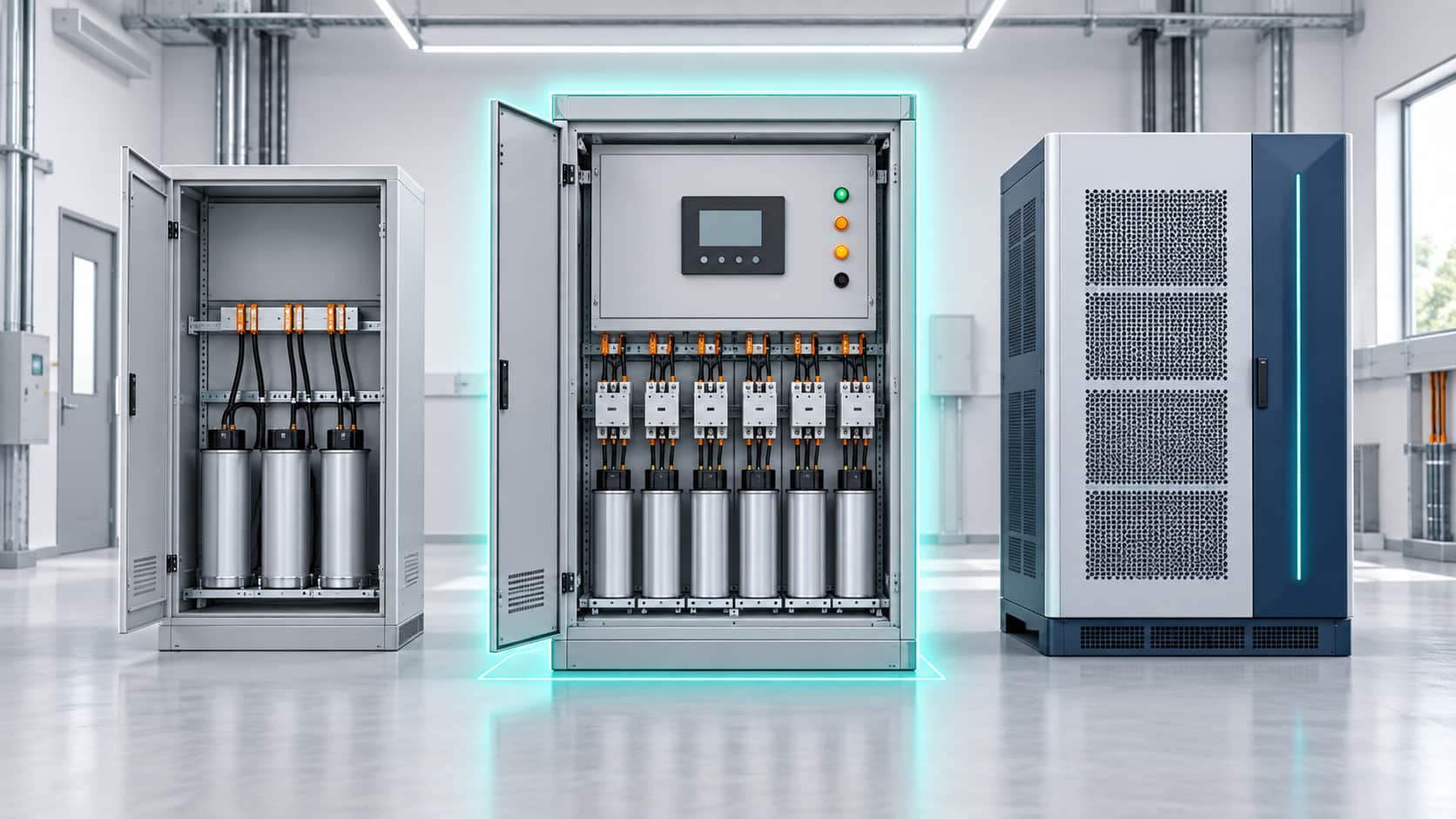
Un banco de capacitores fijo puede mejorar el factor de potencia de manera económica cuando la carga de una instalación permanece casi constante. Pero cuando los motores ciclan o la producción cambia por turno, su compensación puede ser insuficiente en la carga máxima y excesiva durante la noche.
Un generador estático de VAR (SVG) completo sigue los cambios rápidos, pero su mayor costo inicial puede ser difícil de justificar para cargas moderadamente variables. Un panel de corrección automática del factor de potencia (APFC) llena el vacío al conmutar etapas de capacitores a medida que cambia la demanda.
La pregunta es si la velocidad y precisión del APFC coinciden con la carga real.
Un panel APFC no es algo separado de la tecnología de banco de capacitores. Típicamente es un banco de capacitores conmutado con un controlador, transformador de corriente (CT), protección y varias etapas.
Este artículo se centra en el APFC convencional conmutado por contactores. Los paneles conmutados por tiristores pueden responder más rápido, pero aún así cambian la compensación en pasos.
Un banco fijo suministra aproximadamente la misma potencia reactiva siempre que esté conectado. Un controlador APFC conecta o desconecta etapas a medida que cambia la demanda, evitando la compensación innecesaria con carga baja.
Por ejemplo, el APFC puede eliminar etapas cuando las bombas se detienen durante la noche y restaurarlas cuando se reanuda la producción.
Un SVG utiliza electrónica de potencia para una potencia reactiva continuamente ajustable. Sigue el requisito medido en lugar de seleccionar pasos fijos. Puede suministrar compensación capacitiva o absorber el exceso de potencia reactiva capacitiva, sujeto a su capacidad nominal.
El SVG es valioso cuando la demanda cambia más rápido de lo que un panel APFC puede conmutar, cuando se necesita una corrección fina o cuando ocurren factores de potencia tanto inductivos como capacitivos.
Para cambios graduales, los pasos automáticos de capacitores pueden proporcionar una corrección adecuada a un costo inicial menor que un SVG completo comparable. Compare los costos específicos del proyecto.
| Característica | Banco de capacitores fijo | Panel APFC | SVG completo |
|---|---|---|---|
| Cómo se ajusta | No se ajusta automáticamente | Conmuta etapas de capacitores | Varía la salida reactiva continuamente |
| Mejor patrón de carga | Casi constante | Cambia según turnos o ciclos operativos | Cambia rápida o impredeciblemente |
| Tipo de corrección | Capacitiva, cantidad fija | Capacitiva, en pasos | Capacitiva e inductiva, sujeto a capacidad nominal |
| Comportamiento con carga baja | Puede sobrecompensar si se deja conectado | Puede desconectar etapas innecesarias | Puede reducir la salida o absorber el exceso de potencia reactiva |
| Costo inicial típico | El más bajo | Entre el banco fijo y el SVG completo en muchos proyectos | Usualmente el más alto a capacidad comparable |
| Limitación principal | No puede seguir la demanda cambiante | El tamaño del paso y la velocidad de conmutación limitan la precisión | Mayor inversión inicial |
La configuración, la desintonización, la instalación y la capacidad pueden cambiar el costo y el rendimiento reales.
El APFC se adapta a cargas que varían pero que no requieren una corrección segundo a segundo, como turnos de producción, sistemas HVAC escalonados o grupos de motores cíclicos.
El controlador selecciona las etapas requeridas, manteniendo el factor de potencia más cerca del objetivo mientras reduce la sobrecompensación de carga ligera. La planta no necesita pagar por una capacidad de SVG no utilizada.
Un panel APFC es un candidato sólido cuando:
La demanda reactiva cambia, pero no demasiado rápido para los pasos conmutados
El problema principal es el factor de potencia de desplazamiento en retraso
La empresa de servicios públicos aplica un cargo por factor de potencia o energía reactiva
Un banco fijo sobrecompensa con carga baja o subcompensa con carga máxima
El sitio puede corregirse con tamaños prácticos de pasos de condensadores
Se han evaluado los niveles de armónicos y el riesgo de resonancia
El último punto es importante. El APFC hace que un banco de condensadores sea automático; no hace que los condensadores sean inmunes a los armónicos.
El APFC solo puede conmutar sus etapas disponibles. Un paso mínimo sobredimensionado puede causar subcorrección y sobrecorrección. Una soldadora, grúa o elevador puede cambiar la demanda antes de que el panel responda.
Las etapas de condensadores no pueden absorber potencia reactiva capacitiva. Más etapas no resolverán un factor de potencia en adelanto persistente.
Los armónicos son otro límite. Los variadores, rectificadores y sistemas UPS pueden crear corrientes que interactúan con los condensadores y la inductancia del sistema. Un banco APFC desintonizado puede ser apropiado después de un estudio, pero la conmutación no elimina la corriente armónica. La reducción de armónicos puede requerir un filtro armónico activo, no simplemente un SVG.
Registre la demanda reactiva durante la producción máxima, los turnos de carga baja y los fines de semana. Revise la factura de servicios públicos para conocer su objetivo de factor de potencia y las penalizaciones.
Las mediciones deben incluir:
Potencia activa, potencia reactiva y factor de potencia a lo largo del tiempo
Demanda reactiva inductiva mínima y máxima
Cualquier período de factor de potencia en adelanto
Corriente armónica y distorsión de voltaje
Clasificaciones, condición y disposición de conmutación de los condensadores existentes
Carga del transformador, voltaje del sistema y espacio de instalación
Estos datos muestran si el banco puede convertirse a APFC o si necesita nuevas etapas, desintonización o SVG. También informan sobre el tamaño mínimo del paso.
Compare el costo instalado, incluidos los TC, la protección, la desintonización, la puesta en marcha y el mantenimiento. Un precio de gabinete bajo tiene poco valor si el sistema no alcanza su objetivo.
La diferencia de precio solo importa si cada opción cumple con el mismo objetivo medido. Pida a los proveedores que indiquen el factor de potencia objetivo, el rango operativo, los requisitos de respuesta y las suposiciones detrás de la capacidad de kVAr cotizada. Un banco fijo puede tener el precio de compra más bajo, pero aun así dejar sin resolver la sobrecompensación de carga baja. Un panel APFC cuesta más porque añade detección, control y conmutación, pero puede evitar la compra de un SVG completo cuando los cambios son lo suficientemente lentos para los pasos de condensadores.
Para el caso financiero, separe la compra inicial de los costos continuos. Cuente el reemplazo de condensadores y contactores, el acceso para mantenimiento, el trabajo de instalación y la vida útil esperada. Luego compare cualquier penalización tarifaria o restricción de capacidad que el sistema pueda abordar realmente. El APFC no garantiza una reducción en los kilovatios-hora facturados; su valor depende de la carga y la tarifa del sitio.
Un panel APFC normalmente contiene un banco de condensadores, pero añade control automático y etapas conmutadas. Un banco fijo suministra una cantidad constante de compensación mientras está conectado; un panel APFC cambia la cantidad conectada a medida que varía la carga.
Un banco de condensadores con conmutación automática generalmente tiene un costo inicial de equipo más bajo que un SVG completo de capacidad comparable, pero no en todas las configuraciones. La desintonización, el equipo de conmutación, el mantenimiento y la instalación afectan la comparación.
No. Su función principal es la compensación de potencia reactiva. Los reactores desintonizados pueden reducir el riesgo de resonancia, pero se utiliza un filtro armónico activo cuando se debe reducir la corriente armónica en sí.
A veces. Los condensadores deben ser adecuados para la conmutación por etapas y su estado debe ser verificado. La actualización también requiere un TC correctamente ubicado, un controlador, dispositivos de conmutación, protección y una evaluación de los armónicos y los tamaños de los pasos.
Para una carga estable, un banco de condensadores fijo puede ser suficiente. Cuando la demanda cambia a lo largo de la jornada laboral, un panel APFC puede ser una actualización económica: utiliza los pasos de los condensadores de forma más inteligente sin requerir la capacidad total de un SVG. Las condiciones de potencia reactiva rápidas, impredecibles o capacitivas pueden justificar el uso de un SVG en su lugar.
La mejor elección comienza con un perfil de carga, no con una etiqueta de producto. Si su banco fijo ya no mantiene el factor de potencia requerido, YT Electric puede revisar sus mediciones y recomendar si un APFC, un SVG u otra configuración se adapta a sus instalaciones.



 compatible con la red ipv6